

What Is Bullion? Meaning, Types and How It’s Priced
Quick answer: bullion means gold, silver, platinum, or palladium valued purely for its metal content, not its design or rarity.
It’s traded as bars, ingots, or coins based on weight and purity, and its price tracks the live spot price of whatever metal it’s made from.
This article was written by Hercules Tsoutsas, Director of Jaggards, Sydney’s bullion dealer of over 60 years.
Ready to buy your first bar or coin? Our getting started guide walks you through account setup, verification, and payment before you check out.
What Does Bullion Mean, Exactly?
Bullion refers to precious metals, gold, silver, platinum, and palladium, that are traded in bar or coin form based on weight and purity, not appearance or brand.
To define bullion in the simplest possible terms: weight and purity are all that matter, nothing else.
Its value comes almost entirely from its metal content, and the price is set by the metal’s current market price, known as the spot price.
Bullion bars are cast in standardised sizes and act as a straightforward store of value. Coins, on the other hand, are usually minted by a government and carry a face value, though their real worth still comes from the metal itself.
Purity is expressed as a percentage of fineness and stamped directly onto the bar or coin, alongside its weight and the producer’s name.
Larger bars and coins usually carry a lower premium per ounce, which is why bullion is typically sold in ounces, grams, or kilos for bars, and ounces, fractional ounces, or grams for coins.
It helps to keep the meaning of bullion separate from the metal itself. Gold is an element.
Bullion is a product category, a way of packaging and trading that element (or silver, platinum, or palladium) so its value is easy to verify and compare. That distinction is really the whole definition of bullion in a nutshell.
Gold, Silver, Platinum and Palladium Bullion
Gold and silver are the two metals most people mean when they say “bullion,” but platinum and palladium qualify too, provided they meet the same purity and weight standards.
The gold bullion definition comes down to two things: purity and form. The same is true for silver, platinum, and palladium.
Each metal plays a different role in a portfolio. Gold and silver are the most widely traded and easiest to buy and sell locally.
Platinum and palladium tend to appeal to investors chasing extra diversification, largely because of their industrial demand. Our platinum bullion range is worth a look if you want that extra layer of diversification.
Bars vs. Coins: What’s the Difference?
Bullion bars are cast in standardised sizes and serve mainly as a store of value. Coins are usually minted by a government, carry a legal-tender face value, and are often more recognisable and easier to resell for exactly that reason.
Neither is objectively better, it depends on whether you value the lower premiums of bars or the liquidity and collectability of coins. Our guide on what type of bullion you should buy breaks down bars, coins, and rounds in more detail if you’re still deciding.

What Isn’t Bullion? Clearing Up the Definition
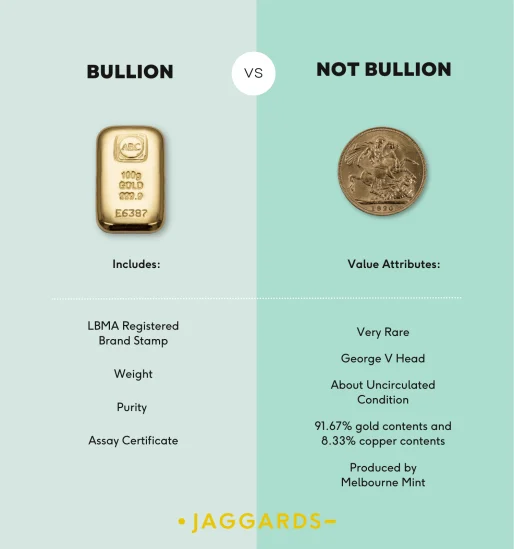
Not every precious metal product qualifies as bullion.
Jewellery, numismatic coins, collectible coins, and scrap gold or silver all fall outside the definition, because their value comes from something other than metal content, think rarity, condition, age, or historical significance.
A gold coin from ancient Rome, for example, might be worth a fortune due to its history, but that value has nothing to do with the current gold price. If you’re curious about the collectible side instead, our rare and collectible coins range sits in a different category entirely.
Likewise, an intricately designed gold ring is valuable as jewellery, not as bullion. To count as bullion, a product has to be valued primarily for its metal content and traded based on weight and purity, full stop.
A simple test: if a product’s price is quoted mainly against the live spot price, it’s bullion.
If it’s quoted against a collector’s catalogue, an auction estimate, or condition grading, it isn’t, no matter how much gold or silver it contains.
Why Do People Invest in Bullion?
Investors buy bullion for a handful of very practical reasons, and gold, silver, platinum, and palladium aren’t bought for the same ones.
Gold as a Safe-Haven Asset
Gold is typically bought as a safe-haven asset and a long-term store of wealth. It’s widely seen as a hedge against inflation, currency swings, and general economic uncertainty.
It’s been trusted and recognised globally for thousands of years.
That’s also why gold tends to move in the opposite direction to riskier assets like shares. When markets get nervous, demand for gold usually climbs.
That’s part of why long-term investors keep a portion of their wealth in it rather than trying to time the market.
Silver’s Industrial Demand
Silver is more of a speculative play by comparison, largely because of its industrial uses. It shows up in electronics, medicine, and solar panels.
That industrial demand means silver prices tend to be more volatile than gold and more exposed to swings in the broader economy.
That volatility cuts both ways. Silver can outperform gold in strong economic periods when industrial demand is high, but it can also fall further and faster when that demand dries up.
Investors who want gold’s stability with some upside potential often hold both.
Platinum and Palladium as Portfolio Diversifiers
Platinum and palladium sit a little further outside the mainstream. Both are used heavily in catalytic converters and other industrial processes, so their prices move with car manufacturing demand as much as with investment sentiment.
That makes them a genuine diversifier for investors who already hold gold and silver and want exposure to a different set of price drivers.
How Can You Tell If Something Is Real Bullion?
Genuine bullion has to tick a specific set of boxes, and knowing them protects you from paying bullion prices for something that isn’t.
Counterfeit and underweight bars do turn up in the market, usually sold cheap through unofficial channels, so it pays to know what a real one looks like before you hand over money.
- Purity Stamp: clearly states the metal’s fineness. Gold bullion is typically .995 fine (99.5%) or higher, silver .999 fine (99.9%) or higher, and platinum or palladium around .9995 fine. This can appear as a decimal (.999) or a percentage (99.9%).
- Metal content declaration: states which metal it is, gold, silver, platinum, or palladium, sometimes using the chemical symbol (Au, Ag, Pt, Pd).
- Exact weight: shown in troy ounces (most common), grams, or kilograms, for example “1 oz,” “100 g,” or “1 kg.”
- Manufacturer or mint mark: identifies the producing mint or refiner. Government mints, LBMA-approved refiners, and reputable private mints all count.
- Additional markings: serial numbers on larger bars, assay certification numbers, year of production, and a legal-tender face value on bullion coins.
For a full rundown of the terms you’ll see stamped on a bar or coin, our glossary is worth bookmarking.
What Is the London Bullion Market Association (LBMA)?
The London Bullion Market Association, or LBMA, sets the standards for gold and silver bullion through its “good delivery” rules for the global over-the-counter market.
Refiners have to meet strict requirements to be LBMA-approved.
- Purity: gold at least .995 fine, silver at least .999 fine.
- Weight: gold bars at a minimum of 350 ounces (10.9 kg), silver bars at a minimum of 1 kg.
- Brand: the refiner must be LBMA-approved and stamp a recognisable brand mark.
- Documentation: a certificate of authenticity and an assay certificate must come with it.
These standards exist to protect investors. They guarantee you’re buying authentic, high-quality bullion that’s easy to buy and sell in the wider market.
Perth Mint and ABC Bullion are two LBMA-approved brands we stock, alongside PAMP, for which Jaggards is the sole Australian distributor.
What Does “The Bullion Market” Actually Mean?
Beyond the products themselves, “the bullion market” refers to the global network of refiners, mints, banks, and dealers who buy, sell, and move physical gold and silver.
It splits roughly into two layers: the primary market, dominated by LBMA members trading large Good Delivery bars, and the retail market, where dealers like Jaggards sell smaller bars and coins to everyday investors.
The bullion market meaning matters here because prices at each layer connect back to the same spot price, just with different premiums layered on top.
A 400-ounce bar traded between banks carries a far smaller premium than a 1-ounce coin sold at retail, because of the extra minting, packaging, and distribution costs involved in the smaller product.
What About Non-LBMA (Private) Bullion Brands?
Private bullion brands and dealers refining their own bars have grown more common in recent years.
They’re not necessarily LBMA-approved, but many still hold high production standards and offer competitively priced gold or silver.
The catch: these bars aren’t always as widely recognised, which can make them harder to resell, and in some cases you’ll only get melt value back when you sell. Our guide to secondary market bullion covers exactly what to watch for if you’re considering one of these.
How Is Bullion Priced? Understanding Spot Price
Bullion’s market price, known as the spot price, moves with supply and demand and reacts to economic conditions, geopolitical events, and currency swings.
It’s the reference point every dealer and investor uses when buying or selling bars or coins. When the spot price of gold rises, gold bullion prices rise with it, and the same goes in reverse for silver.
On top of spot price, you’ll usually pay a small premium, the markup a dealer charges to cover minting, distribution, and their own margin. Our guide on what a bullion premium actually is explains how that markup is calculated and why it varies between bars and coins.
Keeping an eye on the live gold and silver price charts is the easiest way to time your buying and selling decisions.
A Brief History of Bullion
Gold and silver have been used as money and a store of wealth for thousands of years, from ancient Egypt and Rome through to the gold standard era of the 19th and early 20th centuries, when currencies were pegged directly to gold’s value.
That system collapsed in the 20th century, but bullion never stopped being traded. It just shifted from being currency itself to being one of the most trusted stores of value against inflation and uncertainty that exists today.
Buying, Storing and Selling Your Bullion
Once you understand what bullion actually is, the next question is usually practical: where do you buy it, how do you keep it safe, and what happens when you’re ready to sell?
Browse our gold bullion range or silver bullion range to see current bars and coins in stock, all sourced from LBMA-approved mints and refiners.
You don’t need a large budget to start. Entry-level products like small gram bars and fractional-ounce coins exist specifically so newer investors can build a holding gradually.
If you’d rather not store it at home, our secure storage options keep your bullion insured and vaulted, so you’re not relying on a safe under the bed.
And when you’re ready to cash in, Jaggards buys back bullion directly, more on how that works in the FAQs below.
Frequently Asked Questions
Is gold bullion the same as gold coins?
Not always. Some gold coins, like the Perth Mint’s Kangaroo or Lunar Series, are bullion coins because their value tracks the gold price. Other coins are numismatic, meaning collectors pay a premium for rarity or history that has nothing to do with the metal itself. If a coin is marketed for its collectible value rather than its weight and purity, it isn’t bullion in the strict sense.
Is there a difference between “gold bullion” and just “gold”?
Not really. When people talk about gold bullion meaning, they’re describing gold in its purest tradeable form, a bar or coin valued for weight and fineness rather than any other quality. “Gold” on its own can refer to jewellery, electronics-grade gold, or anything containing the metal. Gold bullion narrows that down to the investment-grade product.
How do I know if bullion I’m buying is genuine?
Buy from an established, reputable dealer, check for the purity stamp, weight, and mint mark outlined earlier in this guide, and ask for a certificate of authenticity on any bar over a few ounces. Reputable dealers will also test or verify stock before it ever reaches you.
Is investment-grade bullion GST-free in Australia?
Yes. Under ATO ruling GSTR 2003/10, gold at .995 fine or higher and silver at .999 fine or higher qualifies as GST-free investment-grade bullion, provided it’s in a tradeable bar, wafer, or coin form. Jewellery and other non-investment products don’t qualify.
What’s the minimum amount of bullion I can buy?
There’s no industry-wide minimum. Entry points range from small gram bars right up to kilo bars, so it comes down to your budget rather than a rule. Buying smaller amounts more regularly is a common strategy for investors who’d rather average into the market over time than commit a lump sum at once.
How much bullion should I hold in my portfolio?
There’s no single right answer, it depends on your goals, but many investors treat precious metals as a diversification tool rather than their whole portfolio, holding a modest allocation alongside shares, property, and cash. Speak with a financial adviser about what fits your own situation before deciding on a figure.
What are bullions, and is that even a real word?
“Bullion” is already a mass noun, like “gold” or “furniture,” so strictly speaking there’s no plural. People often say “bullions” when they mean multiple bars or coins, but “bullion” covers any amount, one bar or a vault full.
Can I buy bullion gradually instead of all at once?
Yes. If a lump sum feels daunting, Jaggards runs a savings plan that lets you build a bullion holding through smaller, regular contributions instead of one large purchase. It suits investors who want to dollar-cost average into gold or silver rather than time the market.
Does Jaggards sell platinum and palladium bullion too?
Yes, alongside our main gold and silver stock. Stock levels tend to move faster on platinum and palladium than on gold or silver, so it’s worth checking current availability before you commit to a specific weight or product.
Can I sell my bullion back to a dealer?
Yes, most reputable dealers, including Jaggards, buy back bullion directly. Pricing is generally based on the current spot price, the item’s weight and purity, and sometimes a small margin below spot to cover the dealer’s own resale costs.
Ready to Start Your Bullion Journey?
Now that you know exactly what bullion is and how it’s priced, the best next step is setting up your account. Our getting started guide walks you through verification and payment, so you’re ready to buy the moment you find the right bar or coin.


