

US CPI data inbound and US Internal Conflict causing instability
Spot pricing for Gold $AU6942
Spot pricing for Silver $AU106.42
Spot pricing for Platinum $AU2833
US CPI lands later tonight (AEST), with markets broadly expecting a flat monthly read. If that holds, annual inflation in the United States should remain comfortably within the 2–3% band – right where the Federal Reserve prefers it. For precious metals investors, a steady CPI print removes one layer of uncertainty. It suggests inflation isn’t re-accelerating, but it also isn’t collapsing. In that kind of environment, rate cuts become a slower burn, and gold tends to trade on broader macro drivers rather than panic.
There’s been plenty of macro noise to trade on lately.
One topic that keeps surfacing in discussions is the difference between a “deficit” and “net debt” – two terms often used interchangeably, but they mean very different things.
A deficit refers to the shortfall in a single financial year. If a government spends more than it collects in revenue during that year, it runs a deficit. Think of it as the annual gap between income and expenses.
Net debt, on the other hand, is the accumulation of past deficits (minus any surpluses), adjusted for financial assets. It represents the total amount the government owes after subtracting certain financial holdings. It’s the balance sheet position, not the yearly flow.
Australia’s current fiscal position reflects this distinction clearly. While annual deficits have narrowed at times, structural spending pressures remain. Net debt at the federal level is now approaching the trillion-dollar mark. Crossing that psychological threshold matters less from a technical standpoint and more from a confidence perspective. Investors don’t react to round numbers alone, but they do react to trajectories. When debt continues trending higher relative to GDP, bond markets start demanding a premium. That eventually feeds into borrowing costs, currency pressure, and long-term inflation expectations.
This is one reason the Australian dollar can feel sensitive even when domestic data appears stable. Global capital doesn’t just look at growth – it looks at sustainability.
Meanwhile in the United States, internal political tension continues to simmer. Recent immigration enforcement directives have reportedly led to the detention of more than 65,000 individuals and deportations exceeding 300,000. Regardless of where investors sit politically, rapid policy implementation of that scale introduces friction. Markets dislike friction. Social tension, legal challenges, and state-federal disputes can all create volatility, particularly if they spill into broader economic confidence.
We’re seeing that play out in cross-asset price action. Equity markets remain resilient overall, but volatility spikes are becoming more frequent. That kind of environment tends to quietly benefit gold.
After a severe correction, gold and silver appear to have found their footing. Gold has now moved back above its 50-day moving average, which is technically constructive. Holding above that level suggests the recent pullback may have been a healthy reset rather than the beginning of a deeper unwind. Momentum indicators have cooled from overbought conditions, giving the metal room to move again if macro conditions warrant it.
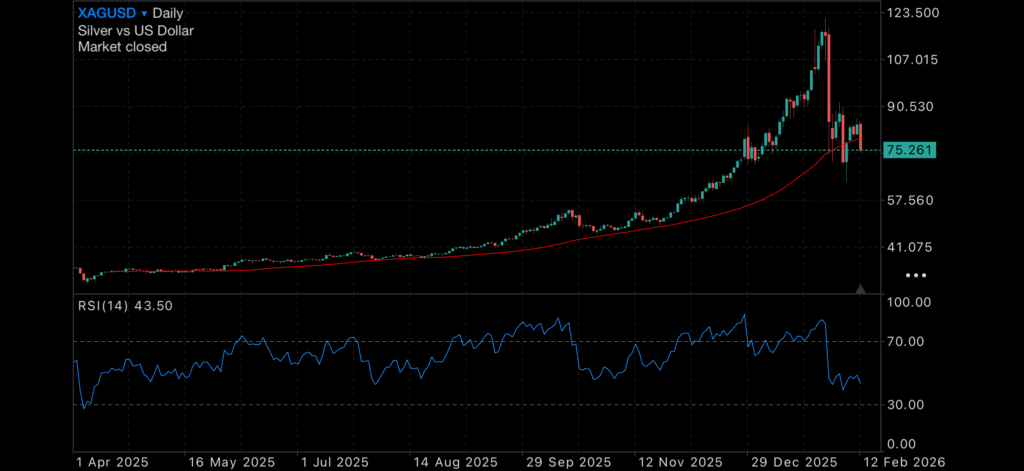
Silver, which tends to amplify gold’s moves, has also stabilised. The key difference this time around is that the correction didn’t coincide with a collapse in inflation expectations or a surge in real yields. Instead, it looked more like position-clearing and profit-taking.
With CPI due shortly, the next directional push may not come from inflation itself, but from how bond markets interpret the data. If inflation remains contained and yields drift lower, precious metals could quietly grind higher again. If inflation surprises to the upside, volatility will return quickly – and gold may find renewed demand as a hedge.
Either way, the bigger picture remains intact. Rising structural debt levels, political friction, and global economic rebalancing continue to provide a supportive long-term backdrop for hard assets.
Always do your own research before making any investment decisions.
Enjoy today’s charts.
Gold Futures Technical Analysis
Technical indicators for Gold Futures suggest a STRONG BUY on both monthly and weekly analyses.
Technical Indicators – Monthly Projections
| RSI(14) | Overbought |
| STOCH(9,6) | Neutral |
| STOCHRSI(14) | Overbought |
| MACD(12,26) | Buy |
| ADX(14) | Overbought |
| Williams %R | Buy |
| CCI(14) | Buy |
| ATR(14) | High Volatility |
| Highs/Lows(14) | Buy |
| Ultimate Oscillator | Buy |
| ROC | Buy |
| Bull/Bear Power(13) | Buy |
Gold daily chart, with 50MDA

Silver daily chart, with 50MDA
US500, with 50MDA

ASX200, with 50MDA


